
360 cameras have a particular feature that is both their strength… and their weakness: their lenses. In order to capture every direction, the two ultra-wide-angle lenses are positioned on opposite sides of the camera body. They protrude significantly from the camera and are therefore highly vulnerable. Until recently, the slightest impact could mean major frustration for users, as the camera had to be sent in for servicing. Since the Insta360 X5, users can replace the lens themselves.
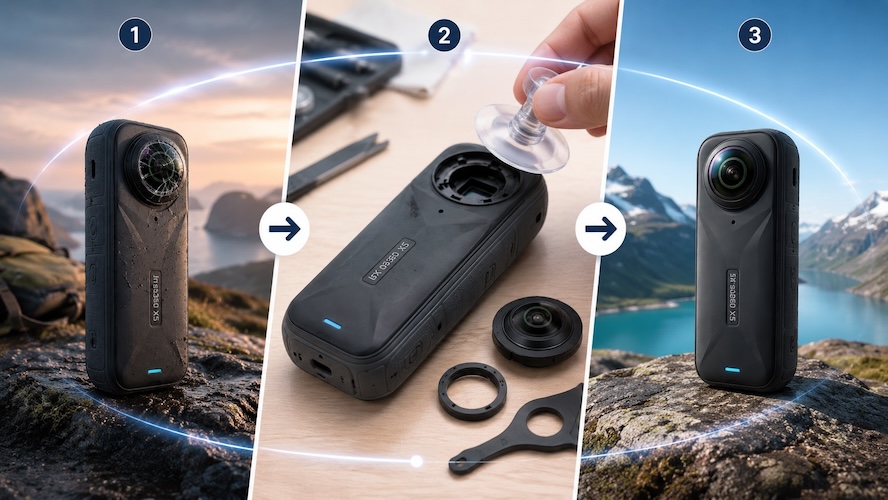
THE IMPACT
When you regularly shoot 360° photos or videos, the question is not really whether a lens will eventually get damaged, but when.
On a conventional camera, the lens is generally protected by the camera body, a lens hood, or simply a lens cap. On a 360 camera, it is quite the opposite: the lenses are deliberately highly exposed.
A camera placed just a little too close to the edge of a table, a selfie stick falling over, a collision with a rock while hiking, a camera sliding across the ground… Sometimes, very little is needed to cause a scratch, chip, or impact on one of the lenses.
A small scratch on a lens does not simply affect one part of the image: it can become highly visible in the final panorama, particularly in brightly lit areas or when a light source is nearby.
A perfectly functional camera can suddenly become almost unusable because of a simple scratch on one of its lenses… which is extremely frustrating for the owner.
For a long time, lens replacement required professional servicing, with all the inconvenience that involved: contacting customer service, shipping the camera, waiting for a diagnosis and repair, and then waiting for the camera to be returned.
Samples of damage can be seen in this article Impact sur lentille 360.
For a photographer who regularly uses a 360 camera, this can potentially mean several days — or even longer — without their camera.
And when the camera is being used for a trip, a documentary project, or professional work, this downtime can be particularly problematic.
THE REPAIR
With the Insta360 X5, Insta360 adopted an interesting approach: the external lenses are now designed to be fully replaceable by the user.
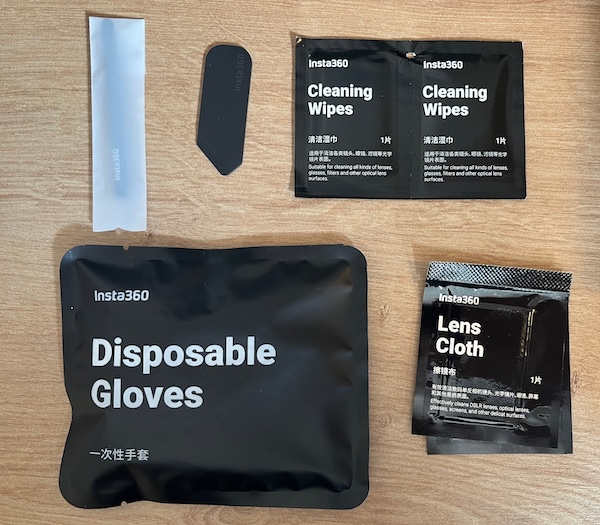
The company offers a replacement kit that includes the replacement lens as well as the tools required for the procedure.
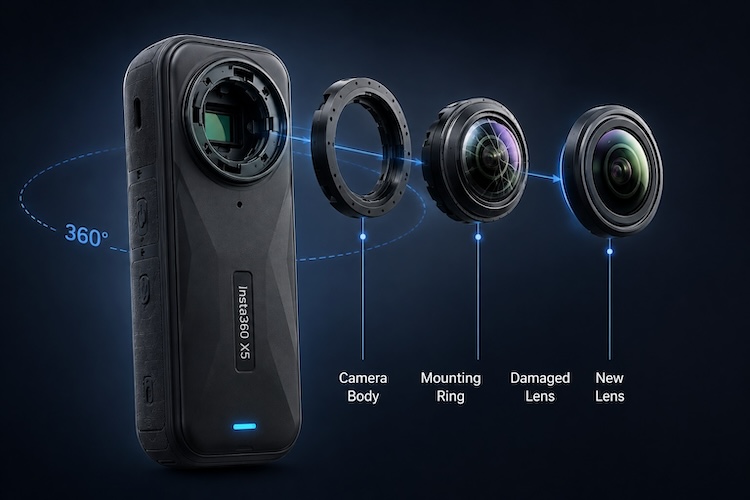
There is no need to disassemble the camera or work on its electronics. The replacement is carried out using the tools supplied with the kit.
The damaged lens is removed using the dedicated tool, and the new optical element is then positioned and secured using the corresponding retaining ring. The kit also includes a suction cup and other tools that allow the different components to be handled without having to touch them directly.
Once the new lens has been installed, the camera simply needs to be calibrated. The user can follow the instructions provided by the camera to complete the process.
So, instead of having to send the camera to a service center, users can now carry out the repair themselves.
BACK TO ADVENTURE
From now on, this ability to repair the camera yourself should become an essential feature of 360 cameras. It is arguably an evolution just as important as improvements in resolution or image quality.
There is one important caveat, though: the fact that the replacement is relatively simple does not mean you can change a lens in the middle of a windy beach or on a dusty trail! This is still a repair, not a lens change like you would perform on a DSLR or mirrorless camera.
Hiking, cycling, skiing, motorcycling, travelling, diving in certain situations, exploration… The activities that make 360 cameras so appealing are precisely those that increase the risk of dropping or damaging them.
A SMALL REVOLUTION, AFTER ALL?
In the past, a simple scratch could turn a perfectly functional camera into a device that had to be sent in for service.
Now, users have a direct solution: replacing a damaged lens no longer necessarily means having a camera sitting in a service center.
For anyone who actually uses their 360 camera out in the field, this is probably one of the most useful improvements of recent years.
It means you can use the camera more freely, without constantly worrying about the slightest scratch.
And ultimately, perhaps that is the most important thing: a 360 camera should make you want to take it with you on an adventure, not leave it in its box because you are afraid of damaging it.
A scratched lens? Replace it. And get back out there.
Leave a Reply